Recent Events

LHF hosts talent showcase of Lao artists May 24  
[more]


Special Announcements

Internationally-recognized Lao poet teams up with award-winning photographer [more]

17 year-old Lao painter launches website [more]

Laos featured on NBC's The Today Show with Matt Lauer
[view]


Projects

Calendar of Events

  << Jul 2008 >>

SMTWTFS
    1 2 3 4 5
6 7 8 9 10 11 12
13 14 15 16 17 18 19
20 21 22 23 24 25 26
27 28 29 30 31    

There are no events in the next 30 days.

Lao Music and Culture

Lao Music - Lao Heritage Foundation

About the Saw

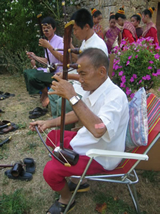
The Lao violin ('saw') is a two-string fiddle. As a matter of convenience, we refer to this instrument as the Lao violin or saw, although it is not unique to Laos; the saw is commonly played in Asia. In Lao traditional music, the saw is only one part of an orchestra, which comprises several types of percussions (gong and kawng wohng), mouth organs made from bamboo (kaen), wooden xylophones (ranahd), cymbals (sing), hammered dulcimer (kim), flutes, and vocals.

The bow is played between the two strings. In a typical saw ensemble, there are four saws, each tuned an octave higher than the next to cover a range of pitches. From the lowest pitch to the highest are: Oh, Ou, E, Leow. The saw is relatively simple, with 10 fingering positions, but is capable of evoking a wide range of emotions.

Tuning

As in all musical instruments, tuning is absolutely important. The low string of one saw is the same note as the the high string of the next saw below it, although the they are 1 octave apart. That is, Leow's low string is the same note as E's high string; E's low is the same as Ou's high; Ou's low is Oh's high. On each saw, the high string is tuned 3 and 1/2 steps higher than the low string. For example, if the low string is tuned to B, then the high string is tuned to F. In an ensemble, it is common practice to let E be the anchor; once E is tuned to itself, everyone else tunes to it directly or indirectly.

As a result of this tuning arrangement, each saw is played differently to produce the same note as other saws.

Notation

We applied the tablature system for guitars to the saw. Tablature shows the placement of fingers (left hand). Therefore, it does not does not require the saw player to know how to read music. On the other hand, rhythm is not precisely conveyed by this system; it requires the player to know the song's rhythm to be able to play it. In the future, we will transcribe songs in standard sheet music to achieve precision.

We have developed an interactive system that allows visitors to our website to create and edit tablature for the saw (membership is required). This system allows the user to convert tablature from one saw to another. It also allows users to copy songs from each other. The ultimate purpose of the system is to create an open environment for saw musicians to create, share, and promote Lao music.

As of March 1, 2006, we have the following songs tabbed for these instruments:

   Dawk Boua Tong (Golden Lotus Flower)  Ou  E  Leow
   Jeen Toom (Chinese Melody)*  Ou  E  Leow
   Jumpa Muang Lao (Plumeria of Laos)*  Ou  Leow
   Lao Douang Deun (Moonlight Serenade)  Ou  E  Leow
   Lao Houam Pao (Celebration of Laos' Diversity)  Ou  E  Leow
   Nang Nahk (River Goddess)  Ou  E  Leow
   Pama Lum Kwan (Burmese Dance)  Ou  E  Leow
   Puak Ka Noy (We the Children)  Ou  Leow

Note: we will make audio files available for these songs soon. For a complete list of songs, click.

*Although Jeen Toom is generically titled, it is considered the most important song in Lao saw playing. It challenges the player with a wide range of notes and an intricate rhythm. As Master Thongtanh puts it, 'it is the gateway to other songs'.

*Jumpa Muang Lao is also very important in Lao music. The melancholy lyrics speak directly to the plumeria, symbol of Lao identity. It provides companionship in loneliness, strength in hardship, and hope in despair. Above all, the song evokes the feeling of love of country.

Reading the Tablature

Each bar is numbered and has two lines. The top line corresponds to the high string; the bottom line corresponds to the low string. The hyphen denotes a sustain (holding the note); the more hyphens, the longer the hold. The ~ (tilda) is a slur between two notes. As a general rule, the sound must not be abruptly silenced, with few exceptions in some songs.

Only one note is played at a time. Where there is one note above another, play either one of the notes, but not both.

Where to Get a Saw

The saw is very difficult to find outside Asia. You can order saws from instrument makers in Luang Prabang through us. This is a great way to support the local Laotian craftsmen. If you're interested, please email us at info@laoheritagefoundation.org.


Press Releases  |  Contacts  |  Privacy Policy  

©2008 Lao Heritage Foundation. All rights reserved.