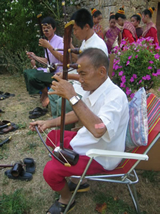
LHF Pacific Northwest hosted 2nd Annual Benefit Dinner and Cultural Show in Seattle area Nov 15 [
|
About the Saw The Lao violin ('saw') is a two-string fiddle. As a matter of convenience, we refer to this instrument as the Lao violin or saw, although it is not unique to Laos; the saw is commonly played in Asia. In Lao traditional music, the saw is only one part of an orchestra, which comprises several types of percussions (gong and kawng wohng), mouth organs made from bamboo (kaen), wooden xylophones (ranahd), cymbals (sing), hammered dulcimer (kim), flutes, and vocals. The bow is played between the two strings.
In a typical saw ensemble, there are four saws,
each tuned an octave higher than the next to cover a range of pitches.
From the lowest pitch to the highest are: Oh, Ou, E, Leow.
When played together, the saw ensemble is capable of evoking a wide range of emotions.
Tuning As in all musical instruments, tuning is absolutely important. The low string of one saw is the same note as the the high string of the next saw below it, although the they are 1 octave apart. That is, Leow's low string is the same note as E's high string; E's low is the same as Ou's high; Ou's low is Oh's high. On each saw, the high string is tuned 3 and 1/2 steps higher than the low string. For example, if the low string is tuned to B, then the high string is tuned to F. In an ensemble, it is common practice to let E be the anchor; once E is tuned to itself, everyone else tunes to it directly or indirectly. As a result of this tuning arrangement, each saw is played differently to produce the same note as other saws. Notation We applied the tablature system for guitars to the saw. Tablature shows the placement of fingers (left hand). Therefore, it does not does not require the saw player to know how to read music. For examples, click here. Where to Get a Saw The saw is very difficult to find outside Asia. You can order saws from instrument makers in Luang Prabang through us. This is a great way to support the local Laotian craftsmen. If you're interested, please email us at info@laoheritagefoundation.org. |